Last updated: June 2026

Author: Rob Lambert
Editor at Arbtech, Rob is a content specialist who manages our ecology and arboriculture services copy to ensure it is accurate, up to date, and insightful for current and future clients.
A preliminary roost assessment (PRA) or bat scoping survey is stage 1 in the bat survey process, and it can be undertaken during daylight hours and at any time of year. Speak to Arbtech for a quick and effective service.



Last updated: June 2026
Editor at Arbtech, Rob is a content specialist who manages our ecology and arboriculture services copy to ensure it is accurate, up to date, and insightful for current and future clients.
Secure your planning permission with a Preliminary Roost Assessment (PRA). Our expert ecologists provide fast, UK-wide bat scoping surveys to identify roosting potential and keep your project moving.
A PRA is a stage 1 bat survey that we can carry out at any time of year. We’ll perform a thorough internal and external inspection of your building to look for evidence of bats or features they might use. A daylight survey is a vital first step for barn conversions, extensions or demolitions to ensure you meet legal requirements.
With prices starting from £399, you get a clear, professional report ready for your local planning authority. We take the stress out of the process, and if you follow our expert advice, we even guarantee planning or your money back.
Why choose us for your PRA:
Year-round surveys: No need to wait for the summer season.
Fast turnaround: We work quickly to prevent any red tape delays.
Expert guidance: Direct advice to help you navigate protected species laws.
Full UK coverage: Local surveyors ready to help you, wherever you are.
Get your project started today with a free, transparent quote.

If you’re planning a new development, barn conversion or even a simple home extension, your local planning authority might not consider your planning application without a bat survey.
Changes to UK law and the introduction of new species regulations supported UK bat species after a steady decline over many years. In most cases, a preliminary roost assessment (PRA) is the exact solution you need to meet the legal obligation and get your planning project moving.
Whether you’re a property developer or a homeowner, we help you identify if the protected species is present so the planning process can continue and you can secure planning permission without any unexpected surprises.
As long as you follow the advice given to you by our experts, we can guarantee planning or your money back.
Also sometimes known as a bat scoping survey or simply as a stage 1 bat survey or phase 1 bat survey, a preliminary roost assessment (PRA) is the initial survey of a development site for bats.
A PRA is a detailed inspection of a building or structure to look for evidence of bats or potential roosting features.
While signs of bat presence could be bat droppings, urine stains or feeding remains, a building’s suitability for roosting bats could be potential access points.
The habitat quality doesn’t even need to be high for more bats to appear on a site, as they can gain access to a site via internal voids, gaps in fascias, soffits and hanging tiles, or cracks in weather-boarding.
If bats are found, a bat emergence and re-entry survey (BERS) will be needed. Otherwise known as a bat activity survey, a bat emergence survey can only be carried out at certain times of the year between late spring and early autumn.
Unlike the phase 2 or stage 2 bat survey and many other protected species surveys, a PRA can be conducted all year round, but only during daylight hours.
It is likely that you will need a bat survey if your development project involves:
It could also be the case that an earlier ecological survey called for a preliminary roost assessment as a precaution to support roosting bats, such as a preliminary ecological appraisal (PEA) or an ecological impact assessment (EcIA).
Bats are legally protected by UK law and European legislation, meaning that the local council must ensure that your plans won’t recklessly disturb, harm or in any way impact bats, or obstruct access to existing roosts or resting places.
A PRA report gives the local authorities trustworthy proof that the steps and recommendations from the ecological consultant map out the best way to continue the plans safely.
With the help of a bat specialist during preliminary bat roost assessments, developers and planners will be given mitigation strategies to avoid committing a criminal offence with their proposed works.
It’s important that your report is accepted by the local council, granting your planning consent and enabling your development to continue.
For that to happen, we need to follow the best practice guidelines of relevant organisations and regulators, particularly the Bat Conservation Trust (BCT).
Other bodies include Natural England and Natural Resources Wales, and bats are also protected under Section 9 of the Wildlife and Countryside Act 1981 and Schedule II of the Conservation of Habitats and Species Regulations 2017.
Alongside other listed protected species, laws prevent anyone from taking actions that could deliberately disturb, injure, capture or kill bats, as well as destroy, damage or recklessly obstruct access to bat roosts.
By following the latest conditions and instructions, we can provide as much information as possible to satisfy the planning department you’re working with.
The bat survey process consists of the following stages:
Performing a desk study before the in-person survey visit.
An ecological consultant will check the surrounding area for existing roosts and bat habitat records to see if any bat species are known to be nearby.
Walking the perimeter of the development site to find potential access points where roosting bats might enter.
Performing a detailed analysis of rooms within the building, with a focus on loft spaces.
High-powered torches and endoscopes will be used to record bat presence or likely absence and find evidence of bats.
Assigning a suitability category to work out the likelihood of bats occupying the site, now or in the future.
Categories range from negligible suitability to high suitability, and the outcome decides if further surveys are needed.
After the initial assessment of the site, a bat survey report will be created.
The PRA report is specifically designed to support planning applications to the local authority by detailing our findings and the potential effects of your planning project on any present bats or roosts.
If the inspection confirms or suspects the presence of bats at any level, the report will outline necessary mitigation measures and compensation measures.
Examples of measures include the installation of bat boxes and GN08/23-compliant lighting strategies to ensure that new light sources do not illuminate roost access points or foraging paths, focusing on keeping sensitive areas below the 0.2 lux threshold using warm-spectrum LEDs (≤2,700K).
The planning project could also impact a bat roost, and if it does, we can help you apply for a bat mitigation class licence. A European Protected Species Licence (EPSL) can be obtained from Natural England or Natural Resources Wales, with the use of a bat licence being a common asset after a PRA.
Every possible issue will be considered, and with that, the bat report will be able to request that the local planning authority grant planning permission.

The team at Arbtech specialise in providing bat surveys that get results based on each licensed bat ecologist having an extensive knowledge and understanding of bat ecology.
We know that the planning process can be frustrating, so we cut through the fluff to give you the facts.
Our experienced ecologists work alongside clients quickly and effectively to ensure that your planning consent with the local planning authorities isn’t held up by red tape or unexpected obstacles.
For clients in cities, the countryside or any other areas across the country, we can help with the next steps to keep development projects moving forward.
As all development proposals are different, we offer a bespoke price for each client. With that, we can eliminate any unfairness that would come from a client paying the same for a large site as they would for a small one.
Instead, the bat scoping survey cost starts at a baseline price of £399+VAT, and it only goes higher if the specific site needs more time or surveyors for the assessment to be completed.
The baseline cost includes everything, such as travel expenses, the entire PRA survey process and your completed bat survey report. Using this approach, all costs are subsidised, we don’t charge mileage, and you’re given a transparent quote before we start.
With professional ecologists all over the UK, we can assist any client, on any site, anywhere.
Under our guidance, you can get your planning project to the next stage and show consideration to protect bats and other protected species.
As the best ecological consultancy in the country, we follow the latest good practice guidelines and offer the most effective way to get a fast and local survey.
If you’re ready to start, you can get a free quote for a preliminary roost assessment survey on your site by completing a quote form on our website, calling our team at head office or sending us an email.
We can then give you an accurate quotation based on your details, and if you’re happy with it, book you in for a PRA at the next available opportunity.
From there, if your development plans call for further bat surveys after a PRA found potential bat roosting sites or evidence of bats, we can also undertake the bat activity surveys in the summer months or bat hibernation surveys in the winter months.
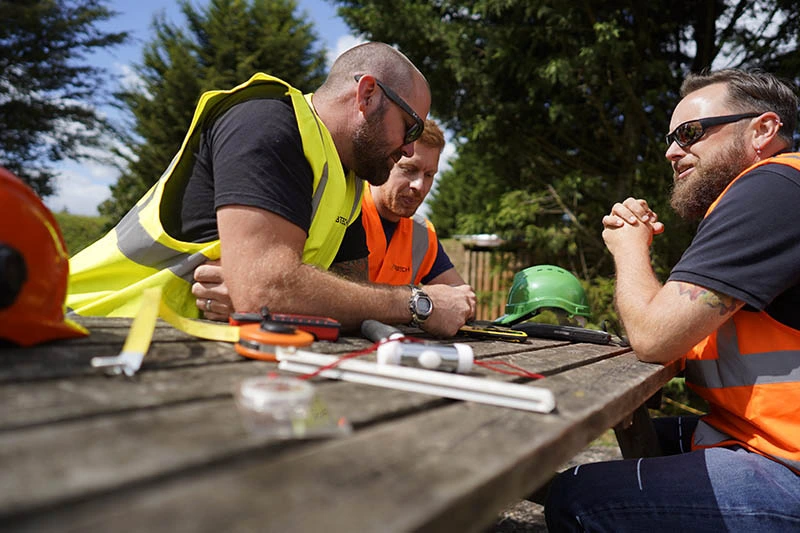
Arbtech are your best asset when it comes to getting planning permission for your project. We cover the whole of the UK and we are waiting to get started on your project...
Get Your Free Quote