Last updated: October 2026

Author: Rob Lambert
Editor at Arbtech, Rob is a content specialist who manages our ecology and arboriculture services copy to ensure it is accurate, up to date, and insightful for current and future clients.
UK’s #1 bat surveyors with hundreds of five-star reviews. Every single year, over 5,000 people choose Arbtech for bat surveys to support planning, from a phase 1 preliminary roost assessment (PRA) to phase 2 bat emergence surveys. Get in touch today for a free quote.



A preliminary roost assessment (PRA) or bat scoping survey is stage 1 in the bat survey process, and it can be undertaken during daylight hours and at any time of year. Speak to Arbtech for a quick and effective service.
Find Out MoreIf bats are on your development site, a bat emergence survey will be needed for you to apply for planning permission. Solely conducted at dusk and dawn over the summer, Arbtech provides bat surveys for developers and planners all over the UK, Get in touch for a free quote.
Find Out MoreOur friendly quote team can answer your questions and provide your quote quickly. Get in touch for your free, no obligation quote.

We will take your details and email you a quote explaining everything you need to know. We will also send a booking form along with your quote.

Complete the booking form and email it back to us. We'll then arrange a date for your survey and get to work.

Once your survey is complete we will write your report quickly and send it over to you when payment is made.
Last updated: October 2026
Editor at Arbtech, Rob is a content specialist who manages our ecology and arboriculture services copy to ensure it is accurate, up to date, and insightful for current and future clients.
To help you secure planning permission, we provide expert bat surveys across the UK. Our team of local ecologists delivers fast, reliable assessments to identify bat roosts and ensure your project stays on track.
Whether you need a preliminary roost assessment or follow-up nocturnal surveys, we simplify the process with clear advice and fixed-fee pricing. We help you navigate legal requirements and work with your local planning authority to prevent costly delays.
All bat species and their roosts are legally protected. If your development affects structures or trees where bats might live, you must prove that your work won’t harm them.
Preliminary Roost Assessment (PRA): A daytime inspection to look for evidence of bats.
Bat Emergence and Re-entry Surveys (BERS): If the PRA finds potential, we monitor the site at dusk or dawn.
Mitigation & Licensing: If bats are present, we design a plan to protect them while moving your project forward.
Speed: We offer the fastest turnaround times in the industry.
Expertise: Our ecologists are fully licensed and local to your area.
Fixed Prices: You get a clear, upfront quote with no hidden extras.

When it comes to getting planning approval for a development project you’re working on, the local planning authority flagging that individual bats may be present on your site can come as a fairly common reason to delay the process.
Bats are protected under the Wildlife and Countryside Act 1981 and the Conservation of Habitat and Species Regulations 2017. With that, developers have a legal obligation to ensure that the proposed works don’t negatively affect bats protected by law.
A professional bat survey is a necessary step to secure planning permission in a way that meets UK law. The team at Arbtech offers bat surveys to support developers and planners, as well as a wide range of other assessments and reports.
A bat survey is an assessment of a development site undertaken by a professional ecologist to confirm if bats and their roosts are present. Physical evidence of bats on a site includes bat droppings, dead bat carcasses, feeding remains and urine stains.
Since bats are a species under legal protection, any development proposal that could potentially disturb them in any way requires an initial assessment to provide the local council’s planning department with as much information as possible.
You will require a survey if there is a reasonable likelihood that the development work you’ve planned could impact bats or bat roosts somewhere on the site.
It could be that your local authority insists that bat surveys are conducted based on certain circumstances of the permitted development, local biological records data pointing towards a UK bat species present, or a bat found on the site in the past.
Alternatively, an initial survey could be needed based on the results of earlier ecological survey work, such as a preliminary ecological appraisal (PEA) or an ecological impact assessment (EcIA).
More often than not, the need for a bat survey will usually apply to barn conversions, re-roofing, tree removal, building conversion, modification or renovation projects on old buildings, the construction of wind turbines, or the demolition of agricultural buildings, livestock buildings or ice houses.
That said, a typical house or even a bungalow can support bats if it has the potential roosting features like missing roof tiles, hanging tiles, wall cavities or weather-boarding.
Although one survey may be enough to rule out the presence of bats on a site, some sites require other surveys to identify the use of the wider landscape.
Our team provides two types of different surveys to support planning applications:
Often referred to as a bat scoping survey or phase 1 bat survey, the preliminary roost assessment (PRA) is the first instance of investigation.
During a site visit, a licensed ecologist will perform an internal and external inspection of the existing building, trees and other structures, depending on the nature of the site.
Internal features will include loft space, small gaps in cavity walls and any roof voids, while external features will include ridge tiles, gable ends, slate roofs and loose bark on trees.
If there are any unseen locations in large trees, tree climbing surveys will be needed, as an aerial inspection to search for habitat features where bats roost. Alternatively, if bats are using underground sites, bat hibernation surveys may be needed.
Based on findings from the site, the report for a PRA will either encourage the local planning authority to grant a planning application or insist on more information through a stage 2 bat survey.
If the PRA report from the stage 1 bat survey identified high suitability for bats, further surveys must be carried out.
Also sometimes known as a bat activity survey, phase 2 bat survey, dusk entry and dawn re-entry surveys, nocturnal bat surveys, bat presence/absence surveys or bat emergence and re-entry surveys (BERS), a bat emergence survey is a more detailed assessment.
Over multiple visits during dusk and dawn, several professional ecologists will record bat activity, with a focus on foraging and commuting bats arriving and departing the site via entry and exit points.
Using highly specialised cameras and bat detector devices, data taken from a number of survey visits will help to identify the bat species, flight lines across the site, population numbers and type of roost, such as hibernation roosts or maternity roosts.
With all the further information now collected, the report for a BERS will explain what needs to be done for the development to move forward without disrupting any present bats.
Once all on-site work is complete, a detailed report will be produced to support the planning project.
Whether it’s a preliminary roost assessment report or a full nocturnal summary, it gives the local planning authority all of the necessary information on bat activity and the existing bat species identified on the site.
Within the report, it will confirm if there is a likely absence of bats or if the site has negligible suitability for roosting in the case of a negative assessment.
If the ecological consultants were successful in finding bats, the report will instead outline the proposed mitigation scheme and necessary mitigation measures, as well as the potential for further surveys required to satisfy planning decisions.
All regulations and requirements surrounding surveys for bats are designed to make sure that your development project complies with UK and European legislation.
Our work is solely conducted based on the Bat Conservation Trust (BCT) best practice guidelines. We also guarantee that every bat survey report we put together integrates the detailed guidance necessary to meet the standards of local authorities and statutory nature conservation organisations.
To ensure your project passes council scrutiny, our mitigation advice is strictly aligned with GN08/23 standards. We specify the use of warm-spectrum lighting (≤2,700K) and directional shielding – such as baffles and hoods – to protect bat roosts and flight paths from light trespass.
The approach we take ensures that every possible factor has been considered and the local authorities have all the additional information they may need to make the right decision when it comes to granting planning consent.
Across phase 1 and phase 2 assessments, various techniques are important in an effective bat survey process.
Our bat survey methodology involves:
In any inspection, we pay particular attention to other evidence from the external and internal inspection, such as potential access points and roosting areas with sufficient habitat suitability.
Beyond an evaluation of buildings, trees or other potential roosting sites, we can determine suitable foraging areas, such as spaces of woodland or water, and important areas used as commuting routes or for foraging habitat.
Based on the building’s suitability, we can categorise it from low to high potential for bats to roost.
Over the space of two to three surveys at dusk, dawn or a mix of the two, experienced ecologists will work together to retrieve key data about present bats.
In larger development proposals, we may also carry out:
Assisting with expert ecological advice, each of our ecological consultants is helped by the use of specialist equipment, including:
Arranging the assessments you need to fit around the bat survey calendar is massively important, especially as it avoids long delays.
While a PRA survey can be done all year round, a BERS survey can only be done at a specific time of year. The phase 2 bat survey is restricted to the summer months, with an optimal time between May and September, a suboptimal time between April and October, and assessments completely out of season between November and March.
Along with performing surveys in a way that doesn’t affect hibernating bats, the appropriate weather conditions can be crucial in phase 1 and phase 2 surveys, as heavy rain and high winds making survey data inaccurate.
If a bat roost is found, it is likely that you will need a bat mitigation licence to proceed lawfully. Or for low-impact projects or only a small number of bats on the site, a bat mitigation class licence (low-impact bat licence) may be required as a faster alternative to ensure legal compliance.
A European Protected Species Licence (EPSL) allows for existing roosts to be moved or destroyed safely and with approval from the local authorities. After that, any missing habitats can be compensated for by installing bat boxes or creating a roof feature designed for roosting bats.
Any time you’re dealing with meeting licensing requirements, our bat consultants can assist with the bat licence application submitted to Natural England or Natural Resources Wales.

We understand that navigating the planning process can be complicated. With that in mind, our ecological consultancy is here to ensure that your development plans move forward without coming up against expensive delays.
In any new development that would benefit from bat surveys, we can conduct the assessment, produce the report, and provide the expert advice needed to protect bats and comply with every legal requirement.
Using a large network of ecological consultants in specific locations across the UK, we can instruct a licensed, trained and qualified ecologist to visit your site for a bat survey and strategically plan it to happen outside of sensitive times of the year.
For even more reasons to choose Arbtech, check out the hundreds of genuine 5-star reviews on our website, reviews.co.uk and Trustpilot.
With every client we speak to, we always aim to create a bespoke quote in the best way possible, formulated on the basis of speed, precision and transparency.
The bat survey cost starts at a universal base fee, only going on to vary based on the size of the site, the complexity of the project, and the amount of time and number of consultants needed to complete the survey process.
Unlike other ecological consultancy service providers, we don’t charge mileage for our consultants to travel to other areas. Instead, we’ve already positioned our team in every part of the country, making our offering quicker and fairer to all clients.
In terms of our pricing, the preliminary roost assessment cost starts at £399+VAT, and the bat emergence survey cost starts at £799+VAT.
If you need a bat survey for your proposed development, reach out to our team with your details, and we will give you a free quote without any hidden costs for you to consider.
Between built-up urban areas and rural communities close to woodland, our bat survey services extend all over England and Wales.
If you require a bat survey, reach out to Arbtech. Our ecological consultants can provide advice on any bat species or roost type on your site, and we’re supported by memberships with the Chartered Institute of Ecology and Environmental Management (CIEEM) and the safety net of professional indemnity insurance.
From conducting a scoping bat survey as a precaution to an activity bat survey as further survey work or a preliminary ecological appraisal for a broader overview, we can provide information and create next steps with mitigation and compensation measures to get your planning project moving in the right direction.
To request a quote from our administration team or simply just for further advice on what you need to push your development forward, contact us over the phone, via email or by filling out a contact form on our website. We can then send you a quote for a preliminary roost assessment, bat emergence survey, or another service to support your plans.
If you have any questions, the bat survey FAQs section below will answer the most common questions we get…
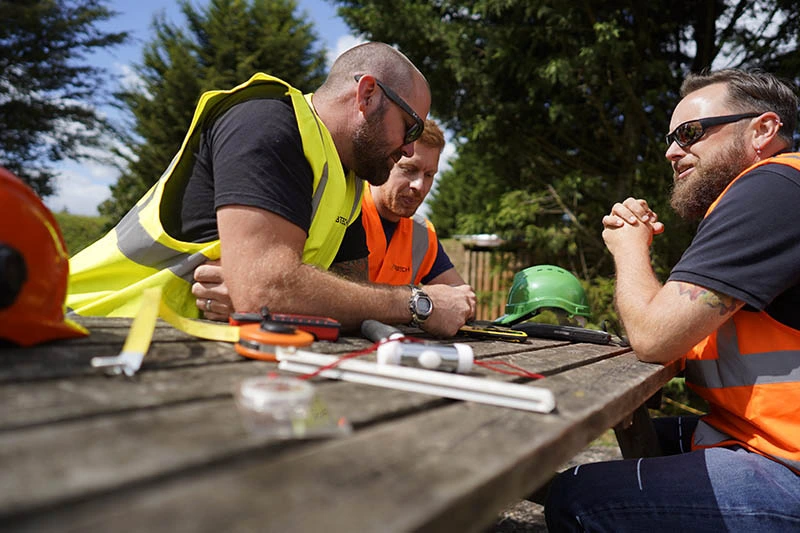
Arbtech are your best asset when it comes to getting planning permission for your project. We cover the whole of the UK and we are waiting to get started on your project...
Get Your Free Quote